
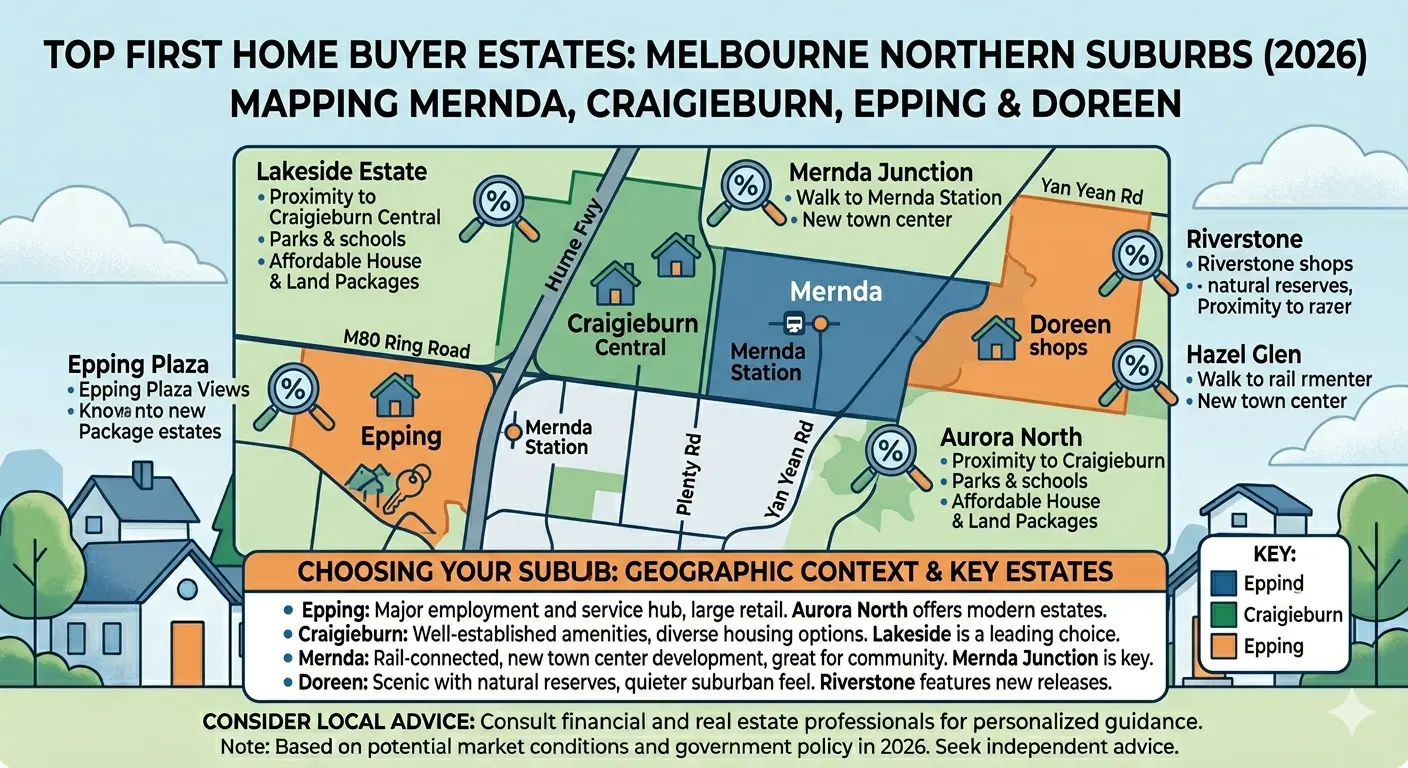
Buying your first home in Melbourne’s northern suburbs has never been more achievable. Between improved first home buyer northern suburbs Melbourne 2026 grant opportunities, RBA rate cuts, and continued estate development across Craigieburn, Mernda, Epping, and Doreen, first home ownership is within reach for more families than ever before.
After guiding 200+ families through their property journeys over 7 years—with over 60% being first home buyers—we’ve seen what works, what doesn’t, and what first-timers wish they’d known before starting.
This comprehensive first home guide Melbourne 2026 walks you through every step: understanding available grants worth $25,000-$66,000, choosing optimal suburbs and estates, selecting builders, budgeting accurately, and avoiding costly mistakes that trap inexperienced buyers.
Whether you’ve saved 5% deposit or 20%, earn $70,000 individually or $120,000 combined, this guide provides a clear roadmap to homeownership in Melbourne’s most affordable and fastest-growing region.
Understanding Your Financial Position
How Much Can You Actually Borrow?
Before falling in love with estates or packages, understand your genuine borrowing capacity.
Basic Calculation:
Lenders assess your ability to service loans based on:
- Gross income (before tax)
- Existing debts (car loans, credit cards, HECS)
- Living expenses
- Interest rate buffers (current rate + 3% typically)
2026 Borrowing Examples:
Single income $80,000:
- No debts: Borrow $420,000-$450,000
- $20,000 car loan: Borrow $380,000-$410,000
Combined income $100,000:
- No debts: Borrow $530,000-$560,000
- $30,000 combined debts: Borrow $480,000-$510,000
Combined income $120,000:
- No debts: Borrow $630,000-$670,000
- $25,000 combined debts: Borrow $580,000-$620,000
These are approximate—actual amounts vary by lender, debt levels, and individual circumstances.
How Much Deposit Do You Need?
Traditional requirement: 20% deposit avoids Lenders Mortgage Insurance (LMI).
First home buyer reality: Most buy with 5-10% deposits using schemes.
Deposit Scenarios:
5% Deposit (First Home Guarantee Scheme):
- $650,000 property: $32,500 deposit
- No LMI required (government guarantee)
- Saves $15,000-$20,000 in insurance
10% Deposit (Standard with LMI):
- $650,000 property: $65,000 deposit
- LMI approximately $15,000-$18,000
- Total upfront: $80,000-$83,000
20% Deposit (No LMI):
- $650,000 property: $130,000 deposit
- No LMI costs
- Lower interest rates available
For most first home buyer northern suburbs Melbourne families, 5-10% deposits are realistic entry points using available schemes.
Grants and Schemes: Maximizing Every Dollar
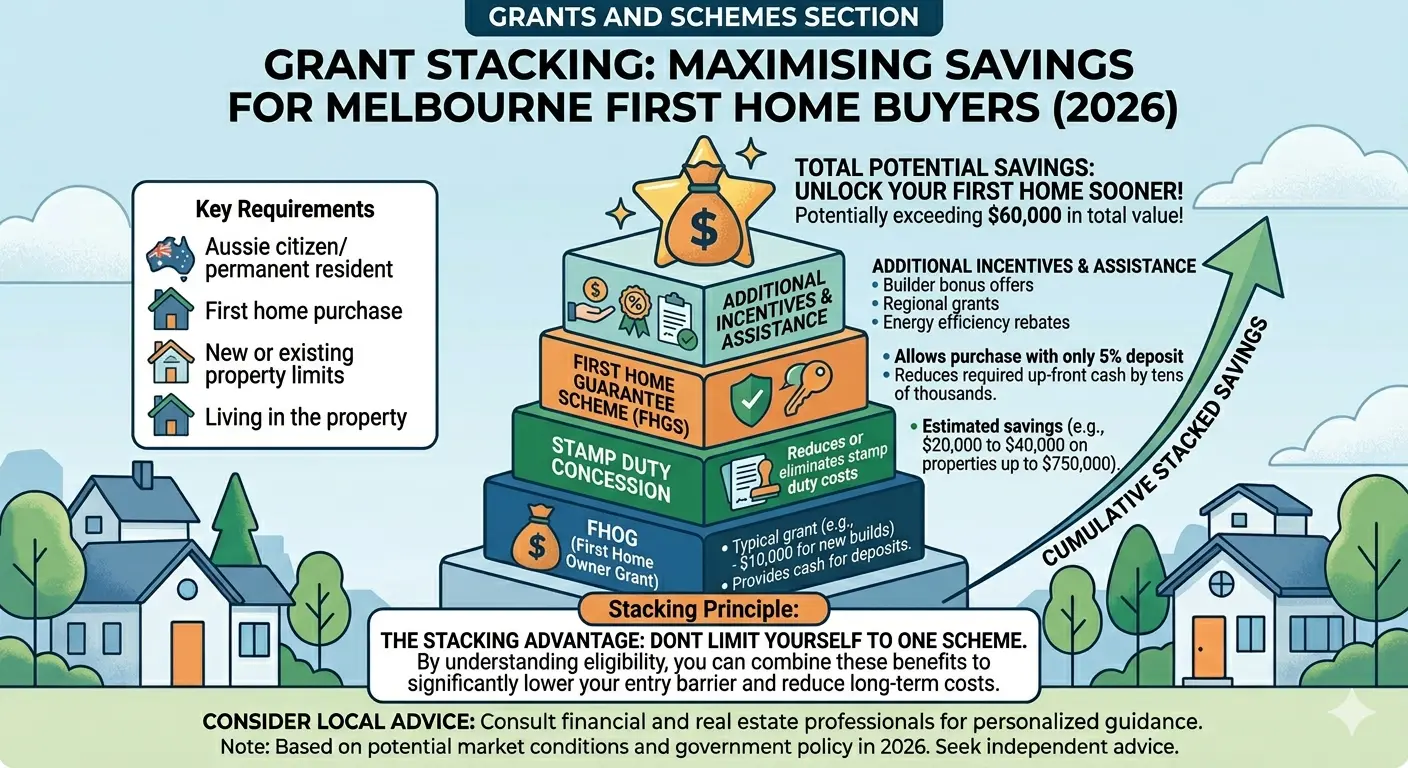
First Home Owner Grant (FHOG)
Amount: $10,000
Eligibility: New home or house & land package under $750,000
Requirements: First home purchase, occupy within 12 months, Australian citizen/permanent resident
Northern Suburbs Application: Nearly all packages in Craigieburn, Mernda, Epping, Doreen under $750,000 qualify. Easy money—always claim it.
Stamp Duty Concessions
Full Exemption: Properties under $600,000 pay zero stamp duty (saves $15,000-$31,000)
Partial Concession: Properties $600,000-$750,000 receive reduced stamp duty
Savings Examples:
- $550,000 package: Save $28,000 (full exemption)
- $650,000 package: Save $21,500 (partial concession)
- $750,000 package: Save $15,000 (partial concession)
Strategy: This is huge. If choosing between $595,000 and $605,000 packages, the cheaper one saves extra $10,000+ in stamp duty beyond base price difference.
First Home Guarantee Scheme (FHGS)
Benefit: Buy with just 5% deposit, government guarantees remaining 15% (avoiding LMI)
Eligibility: First home buyer, income under $125,000 single/$200,000 couple, property under $800,000
Quota: Limited places annually—apply early
Savings: $15,000-$25,000 in LMI costs while buying years earlier than saving 20% deposit.
Reality Check: Most northern suburbs packages under $800,000, so nearly all first home buyers qualify if income eligible.
Grant Stacking: The Power Combo
Smart first home buyers combine all three:
Example: $650,000 Mernda package, 5% deposit ($32,500)
- FHOG: $10,000
- Stamp duty concession: $21,500
- FHGS (LMI saving): $18,000
- Total value: $49,500
This transforms affordability. Without grants, you’d need $130,000+ upfront (20% deposit). With grants, $32,500 deposit plus $49,500 benefits gets you in.
Budget Planning: The True Cost
Beyond the Advertised Price
First home buyer mistake #1: Budgeting only advertised package price.
Complete Budget Breakdown:
$650,000 Advertised Package:
- Land + Build: $650,000
- Stamp duty: $0 (exemption under $600,000) or $8,000 (if over)
- Site costs: $5,000-$15,000 (depending on block)
- Essential upgrades: $12,000-$20,000 (dishwasher, heating, cooling)
- Landscaping/fencing: $15,000-$20,000
- Driveway/paths: $8,000-$12,000
- Connection fees: $4,000-$6,000
- Legal/conveyancing: $1,500-$2,500
- Building inspection: $500-$800
- Realistic total: $696,000-$726,000
Add 10-15% buffer: Another $70,000-$109,000 for unexpected costs, variations, holding costs during build.
True budget for $650,000 package: $766,000-$835,000
Monthly Holding Costs During Build
Most overlook costs during 6-12 month build period:
If Renting:
- Continue paying rent: $450-$550/week = $11,700-$14,300 (6 months)
- Construction loan interest on drawn funds
- Total: $15,000-$20,000
If Living with Parents:
- Construction loan interest only
- Total: $8,000-$12,000
Monthly Costs After Moving In
Loan Repayments:
- $650,000 loan at 5.5%: $3,690/month
- $700,000 loan at 5.5%: $3,973/month
Ongoing Costs:
- Council rates: $150-$200/month
- Water rates: $80-$120/month
- Insurance: $100-$150/month
- Utilities: $200-$300/month
- Maintenance: $100-$200/month
- Total ongoing: $630-$970/month
Combined housing costs: $4,320-$4,943/month on $650,000 loan.
Income requirement: Minimum $100,000-$120,000 household income for comfortable living.
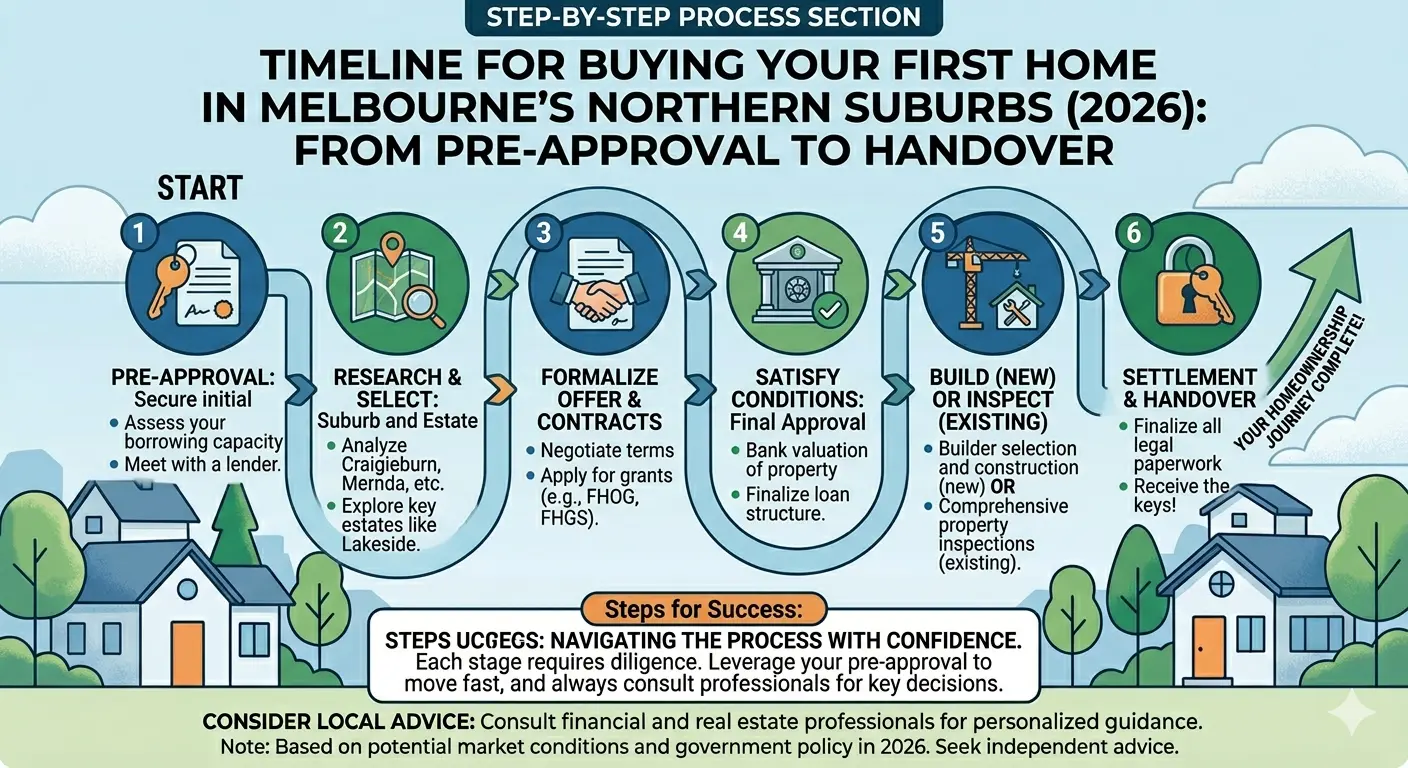
The Step-by-Step Process
Step 1: Get Finance Pre-Approval (Week 1-2)
Action: Approach 2-3 lenders or mortgage broker for pre-approval.
You’ll Need:
- Payslips (last 3 months)
- Tax returns (last 2 years if self-employed)
- Bank statements (last 3-6 months)
- ID documents
- Details of debts/assets
Outcome: Know exact borrowing capacity before house hunting. Sellers take you seriously. Move quickly when right property appears.
Step 2: Research Suburbs and Estates (Week 2-4)
Action: Visit estates on weekends, attend display homes, research online.
Compare:
- Package pricing and what’s included
- Estate amenities (parks, playgrounds, shopping proximity)
- School zones and availability
- Block sizes and orientations
- Covenant requirements
- Future development plans
Outcome: Shortlist 3-5 estates matching budget, lifestyle priorities, and investment goals.
Step 3: Package Selection and Negotiation (Week 4-8)
Action: Select specific packages, negotiate pricing and inclusions.
Negotiate:
- Base package price (sometimes $5,000-$15,000 reduction possible)
- Free upgrade inclusions (stone benchtops, upgraded flooring)
- Landscaping/fencing allowances
- Extended settlement periods
- Removal of unfair contract conditions
Outcome: Secure package at best possible price with optimal inclusions.
Step 4: Builder Vetting and Due Diligence (Week 6-9)
Action: Independently assess builder before signing contracts.
Check:
- Financial stability (insurance, trading history)
- Consumer Affairs Victoria complaints
- Recent completed builds in your estate
- Real client references (not builder-provided)
- Contract terms and fairness
Outcome: Confidence your builder will deliver quality on time without financial stress.
Step 5: Contract Review and Signing (Week 10-12)
Action: Review building contract line-by-line before signing.
Critical Clauses:
- Variation provisions (are they capped or unlimited?)
- Payment schedule (fair progress-based or builder-favoring?)
- Completion date and delay penalties
- Defect liability period and coverage
- Termination rights for both parties
Outcome: Fair contract protecting your interests throughout build.
Step 6: Finance Approval and Settlement (Week 13-16)
Action: Convert pre-approval to formal approval, settle land purchase.
Process:
- Submit formal loan application with signed contract
- Lender orders property valuation
- Formal approval issued (1-2 weeks)
- Settle land purchase
- Construction loan established
Outcome: Finance locked in, land owned, construction ready to commence.
Step 7: Construction Phase (Month 5-11)
Action: Monitor progress, manage variations, approve stage payments.
Involvement:
- Site visits every 2-4 weeks
- Approve variation requests (or reject unreasonable ones)
- Sign off stage completions before progress payments
- Monitor quality and raise concerns early
Outcome: Build progresses smoothly with quality outcomes.
Step 8: Pre-Handover and Moving In (Month 11-12)
Action: Independent defect inspection, negotiate rectification, practical completion.
Final Steps:
- Independent building inspection (crucial!)
- Compile defect list
- Negotiate builder rectification before signing completion
- Final loan draw-down
- Receive keys and move in
Outcome: Move into quality new home with defects addressed.
Total Timeline: 12-18 months from starting research to moving in.
Common First Home Buyer Mistakes to Avoid
Mistake 1: Choosing Based on Price Alone
The Trap: “This package is $30,000 cheaper—let’s buy it!”
Reality: Cheapest packages often have smallest blocks, worst orientations, furthest from amenities, or less reputable builders. That $30,000 “saving” costs $50,000+ in lower quality, harder resale, and higher ongoing costs.
Better Approach: Compare like-for-like. Prioritize quality location and builder over rock-bottom pricing.
Mistake 2: Maxing Out Borrowing Capacity
The Trap: “Bank approved $650,000—let’s borrow $650,000!”
Reality: Banks approve what you can technically service, not what’s comfortable. Life happens—job changes, babies, car breakdowns. Maxed borrowing leaves zero buffer.
Better Approach: Borrow 10-15% below maximum capacity. This cushion saves stress and prevents financial strain.
Mistake 3: Skipping Builder Due Diligence
The Trap: “Display homes look great—this builder must be good!”
Reality: Display homes are marketing. Actual quality varies wildly. Some builders showing beautiful displays are financially stressed, have poor track records, or use unfair contracts.
Better Approach: Independently vet builders through financial checks, Consumer Affairs searches, real client references, and completed build inspections.
Mistake 4: Accepting First Offers Without Negotiation
The Trap: “Estate agent said this is their best price.”
Reality: Everything is negotiable—package pricing, upgrade inclusions, contract terms, settlement timing. Accepting first offers leaves $10,000-$20,000 on table.
Better Approach: Research comparable packages, identify negotiation leverage, make informed counter-offers, walk away if necessary.
Mistake 5: Underestimating Total Costs
The Trap: “We’ve saved enough for deposit—we’re ready!”
Reality: Beyond deposit, you need funds for site costs, upgrades, landscaping, holding costs, stamp duty (if applicable), legal fees, moving costs. Underfunding causes mid-build financial stress.
Start Your First Home Journey with LT Property Solution Group
Navigating the first home buyer northern suburbs Melbourne 2026 journey alone is overwhelming—and expensive mistakes are common without expert guidance.
At LT Property Solution Group, we’ve guided 120+ first home buyers through northern suburbs purchases over 7 years. We know which estates offer genuine value, which builders deliver quality, and how to maximize your grant benefits while avoiding traps.
How We Help First Home Buyers:
- Grant Maximization: We ensure you access every available dollar—FHOG, stamp duty concessions, FHGS—securing $25,000-$66,000 in combined benefits.
- Suburb Selection: We identify optimal suburbs and estates matching your budget, priorities, and goals based on actual market knowledge, not sales hype.
- Package Analysis: We compare packages across estates, identify hidden costs, and negotiate better pricing and inclusions saving average $12,000-$18,000.
- Builder Vetting: We independently assess builders, rejecting 60% who don’t meet our standards, preventing you from signing with problem operators.
- Contract Protection: We review contracts line-by-line, negotiating fairer terms protecting your interests throughout the build.
- Budget Planning: We create realistic budgets covering all costs, preventing mid-build financial surprises.