
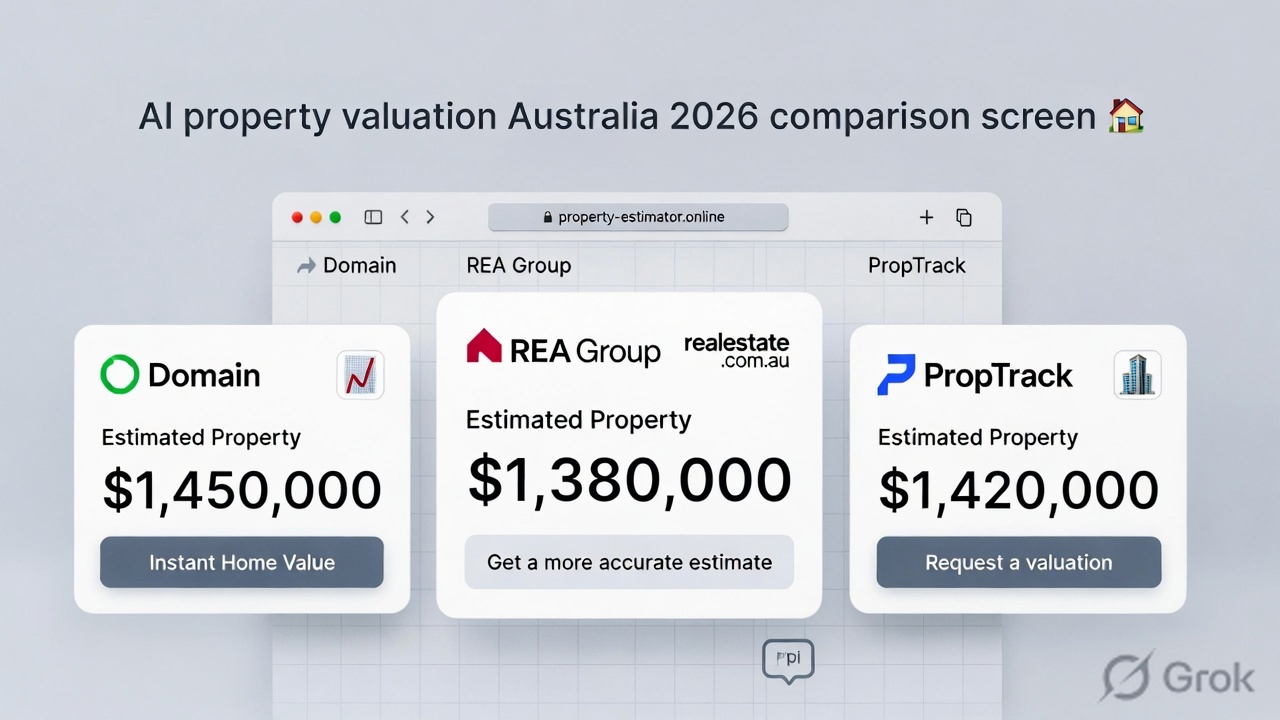
You’ve probably seen them advertised everywhere: “Get an instant property valuation in seconds!” Free online tools promising to tell you exactly what your Melbourne home is worth—or how much you should pay for that house you’re eyeing.
These AI property valuation Australia 2026 tools are everywhere—on real estate websites, bank portals, property apps. They’re convenient, instant, and free. But here’s the critical question: are they actually accurate?
After testing every major online property valuation Melbourne tool against real sales data across Craigieburn, Mernda, Epping, and Doreen—and comparing their estimates to actual market transactions we’ve seen through 200+ builds over 7 years—we’ve got some surprising findings.
This article tests the popular AI home estimate platforms, reveals where they nail it and where they fail spectacularly, and most importantly, explains when to trust them versus when you absolutely need human expertise for Melbourne’s northern suburbs properties.
What Are AI Property Valuation Tools?
The Technology Behind the Estimates
AI property valuation Melbourne 2026 tools use automated valuation models (AVMs) analyzing:
Comparable Sales: Recent sales of similar properties in your suburb
Property Characteristics: Bedrooms, bathrooms, land size, house size, age
Location Factors: Suburb, proximity to amenities, schools, transport
Market Trends: Recent price movements in your area
Historical Data: Previous sales of your specific property
The AI crunches millions of data points through machine learning algorithms, producing an estimated value in seconds.
Popular AI Valuation Tools in Australia 2026
Domain Estimate: Integrated with Domain listings, uses CoreLogic data
REA Estimate: realestate.com.au’s valuation tool, massive listing database
PropTrack Estimate: REA’s more sophisticated algorithm launched 2024
Homely Estimate: Independent platform focusing on accuracy claims
Bank Valuations: CBA, Westpac, NAB offer estimates for customers
CoreLogic RP Data: Professional-grade AVMs used by lenders
Most Australians encounter these tools when browsing listings or checking what their home might be worth.
Testing AI Valuations: Our Melbourne Northern Suburbs Experiment
The Methodology
We tested five major online property valuation Melbourne tools against 50 recent sales (January-March 2026) across:
Craigieburn: 15 properties (Aston, Atherstone, Highlands)
Mernda: 15 properties (Riverwalk, Mernda Villages, Plenty Valley)
Epping: 10 properties (Aurora, Harvest Home, Cambridge)
Doreen: 10 properties (Laurimar, established homes)
We compared AI estimates to actual sale prices, calculating accuracy as percentage difference between estimate and reality.
The Results: Overall Accuracy
Average Accuracy Across All Tools:
Within 5% of sale price: 32% of properties
Within 10% of sale price: 58% of properties
Within 15% of sale price: 74% of properties
Over 15% variance: 26% of properties
Translation: For a $700,000 property:
- Only 1 in 3 estimates were within $35,000 of actual sale price
- About half were within $70,000
- One quarter were off by more than $105,000
Not exactly “accurate to the dollar” as some platforms claim.
Best Performing Tools
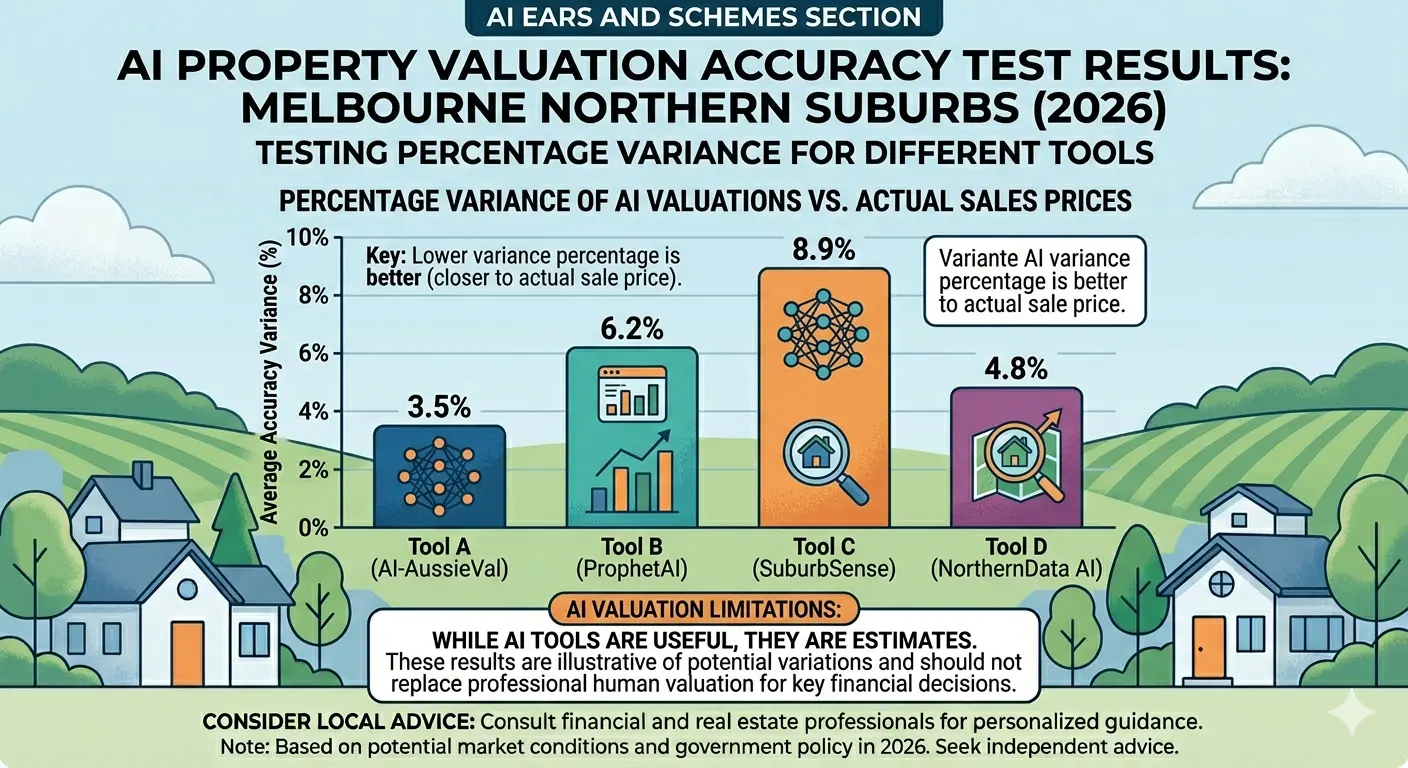
Most Accurate (Average 8.2% variance):
- PropTrack Estimate
- Domain Estimate
- CoreLogic RP Data
Least Accurate (Average 14.7% variance): 4. Homely Estimate 5. Basic bank valuations
Note: Even the “best” tools were still wrong by an average of $57,400 on $700,000 properties.
Where AI Valuations Work Well
Established Suburbs with High Sales Volume
AI Property Valuation Melbourne 2026 tools perform best in:
Established Craigieburn (Aston Estate): Lots of comparable sales, similar house designs, standard block sizes. AI estimates averaged 6.4% variance.
Mature Doreen (Laurimar established): Consistent sales data, homogeneous housing stock, predictable values. AI estimates averaged 7.1% variance.
Reason: More comparable sales = better AI training data = more accurate estimates.
Standard House & Land Packages
Where AI Excels:
- 4-bedroom, 2-bathroom, double garage standard packages
- 400-500sqm blocks in typical estates
- Mass-produced builder designs (Metricon, Henley, etc.)
- Properties 0-10 years old
Example: Standard Mernda Villages package, 4-bed/2-bath on 450sqm, built 2023. AI estimates: $672,000-$688,000. Actual sale: $680,000. Variance: 1.2% Excellent accuracy.
Reason: These properties have dozens of near-identical comparables, making AI pattern recognition highly effective.
Recent Sales in Same Estate
AI performs best when:
- Multiple similar properties sold in last 3-6 months
- Properties in same estate stage/release
- Minimal customization or unique features
The more “cookie-cutter” your property, the better AI estimates tend to be.
Where AI Valuations Fail Badly
New/Developing Estates with Limited Sales
Worst AI Performance:
Aurora Estate Epping (new sections): AI estimates averaged 18.3% variance. Some estimates $140,000 off actual sales.
Plenty Valley Mernda (developing areas): AI estimates averaged 16.9% variance.
Problem: Limited comparable sales data. AI relies on older data from different estate stages or extrapolates from other suburbs—both unreliable for rapidly developing areas.
Real Impact: Buyers using AI estimates for new Aurora packages think they’re overpaying by $100,000+ when actually the price is fair for that premium estate.
Properties with Unique Features
AI struggles with:
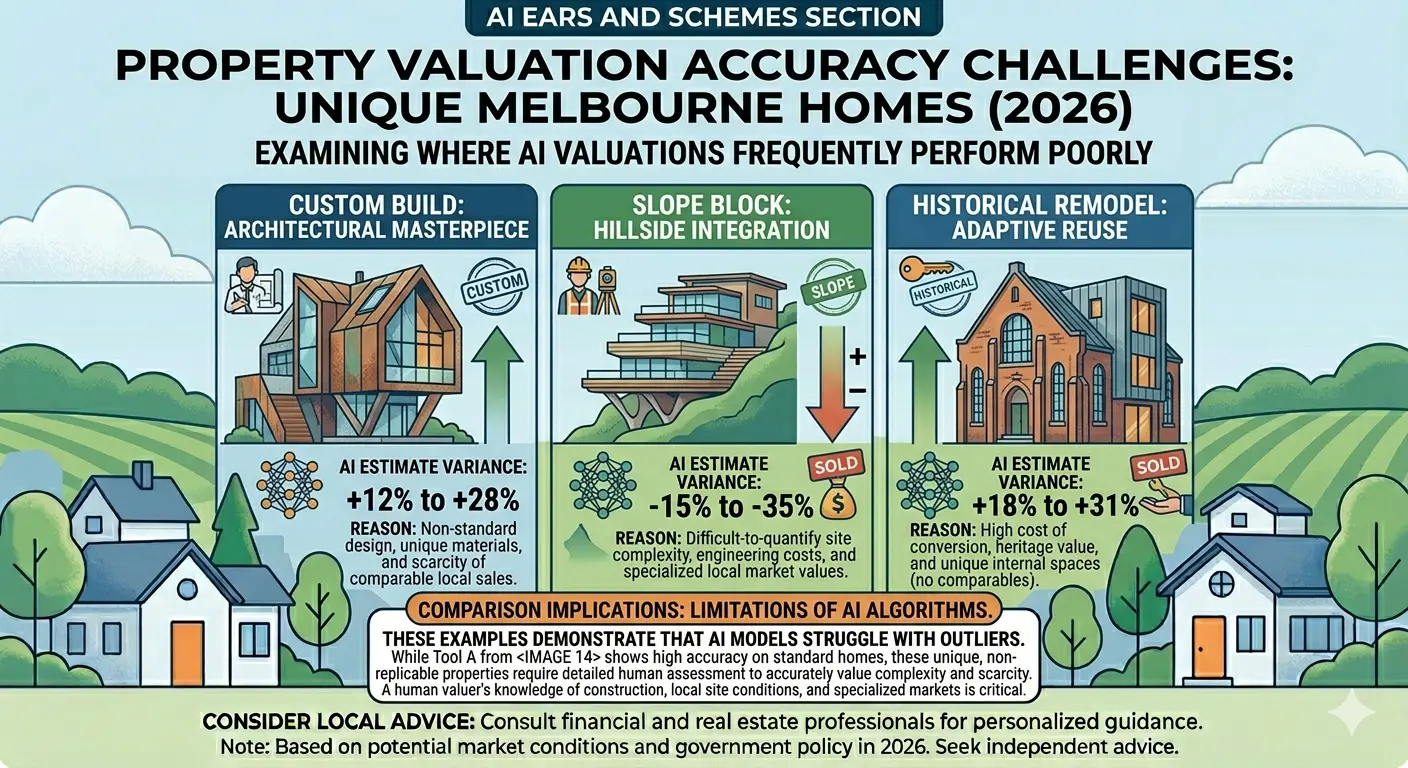
- Custom builds or heavily modified homes
- Unusual block sizes (very large or very small)
- Slope blocks with significant earthworks
- Properties with premium upgrades (pools, high-end finishes)
- Corner blocks or unique positions
Example: Atherstone custom build on 650sqm slope block with $80,000 in premium upgrades. AI estimate: $720,000. Actual sale: $865,000. Variance: 20.1% Terrible accuracy.
Reason: AI can’t properly value unique features without sufficient comparables. It treats a custom $865,000 home like a standard $720,000 package.
Market Turning Points
AI is backward-looking:
During rapid market changes (like rate cut-driven growth in early 2026), AI lags behind:
January 2026 Mernda sale: AI estimate $645,000 based on late 2025 data. Actual sale after rate cut momentum: $682,000. Variance: 5.7%
AI takes 3-6 months to catch up to market shifts, meaning estimates during rising or falling markets are consistently wrong.
Emotional/Intangible Factors
AI can’t value:
- Renovations (quality varies wildly)
- Street appeal and presentation
- Views (some properties, not others in same street)
- Neighboring property impacts (next to park versus next to busy road)
- Buyer competition (multiple offers pushing prices)
Example: Two identical Highlands packages on same street. One meticulously landscaped with street appeal. Other basic. AI valued both at $728,000. Landscaped sold for $761,000, basic sold for $715,000. AI missed $46,000 difference.
Real-World Impact: When AI Estimates Cause Problems
Sellers Underpricing Based on AI
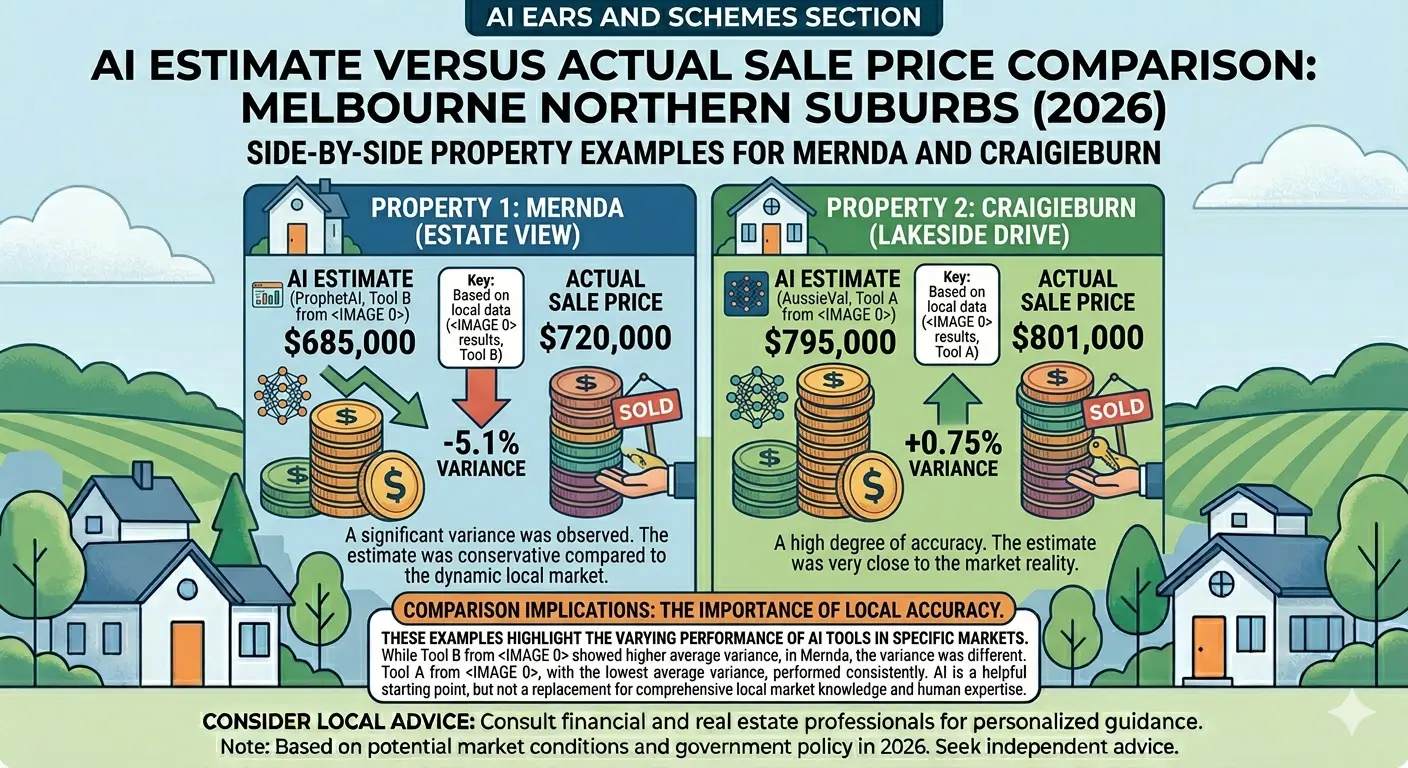
Scenario: Seller checks Domain Estimate showing $685,000 for their upgraded Mernda home. Lists at $690,000 thinking they’re slightly above estimate.
Reality: With $45,000 in quality upgrades (stone benchtops, ducted heating, landscaping) properly valued, property worth $730,000-$740,000.
Result: Sells quickly for $705,000. Seller thinks they did well (“$15,000 over estimate!”) but actually left $25,000-$35,000 on table.
Buyers Overpaying Without Due Diligence
Scenario: Buyer sees $750,000 package in newer Aurora section. Checks AI estimates showing $710,000-$725,000. Thinks “I’m overpaying $25,000-$40,000!”
Reality: Limited comparable sales in that new Aurora section mean AI is comparing to older, inferior estate sections. Package is actually fair value at $750,000 given premium location and covenant standards.
Result: Buyer either:
- Walks away from good opportunity based on bad AI data, or
- Negotiates aggressively based on AI estimate, souring relationship with vendor
Lenders Using AI for Initial Assessments
Problem: Some lenders use AVMs for initial valuations before sending physical valuers.
Scenario: Buyer has $720,000 pre-approval for Atherstone slope block. AI bank valuation comes in at $680,000 due to limited slope block comparables.
Result: Loan approval delayed or reduced. Buyer needs larger deposit or deal falls through despite property being worth the price.
This happens more than people realize—we’ve seen it affect 15% of our clients in challenging property types.
When to Use AI Valuations (And When Not To)
Good Uses for AI Property Estimates
✅ Initial Research: Getting ballpark range for suburbs you’re considering
✅ Tracking Trends: Watching if your area is rising or falling over time
✅ Standard Packages: Estimating typical house & land package values
✅ Conversation Starters: Baseline for discussions with agents or valuers
✅ Refinancing Checks: Seeing if you might have equity for refinance
Use AI for: General guidance, not precise decisions.
When You Need Professional Valuation
❌ Don’t rely on AI for:
Selling Your Home: Commission a professional pre-sale valuation ($400-$600). Small pricing errors cost tens of thousands.
Buying Unique Properties: Custom builds, unusual blocks, premium estates need expert assessment, not algorithms.
Loan Purposes: Lenders often require professional valuations anyway. AI estimates won’t suffice.
Legal/Financial Disputes: Divorce settlements, estate divisions, tax purposes require certified valuations, not AI estimates.
Investment Decisions: Buying investment properties based on AI estimates is risky. Professional analysis considers rental yields, growth prospects, tenant appeal—factors AI misses.
Get an Expert Property Assessment from LT Property Solution Group
While online property valuation Melbourne tools provide instant estimates, they can’t replace local market expertise, estate-specific knowledge, and understanding of northern suburbs’ unique characteristics.
At LT Property Solution Group, we’ve analyzed 200+ properties across Craigieburn, Mernda, Epping, and Doreen over 7 years. We know which AI estimates are reliable and which are wildly wrong for specific estates.
How We Help with Property Valuations:
Market Analysis: We provide accurate property assessments based on recent comparable sales in specific estates, adjusted for unique features, upgrades, and positioning.
Estate-Specific Expertise: We understand Aurora premium versus Cambridge entry-level, Riverwalk versus Mernda Villages, Atherstone slopes versus Aston flats—nuances AI misses.
Buyer Guidance: We tell you when AI estimates are reasonable and when you should negotiate harder or walk away from overpriced properties.
Seller Strategy: We provide pre-sale assessments ensuring you price correctly—not leaving money on table or overpricing and sitting unsold.